
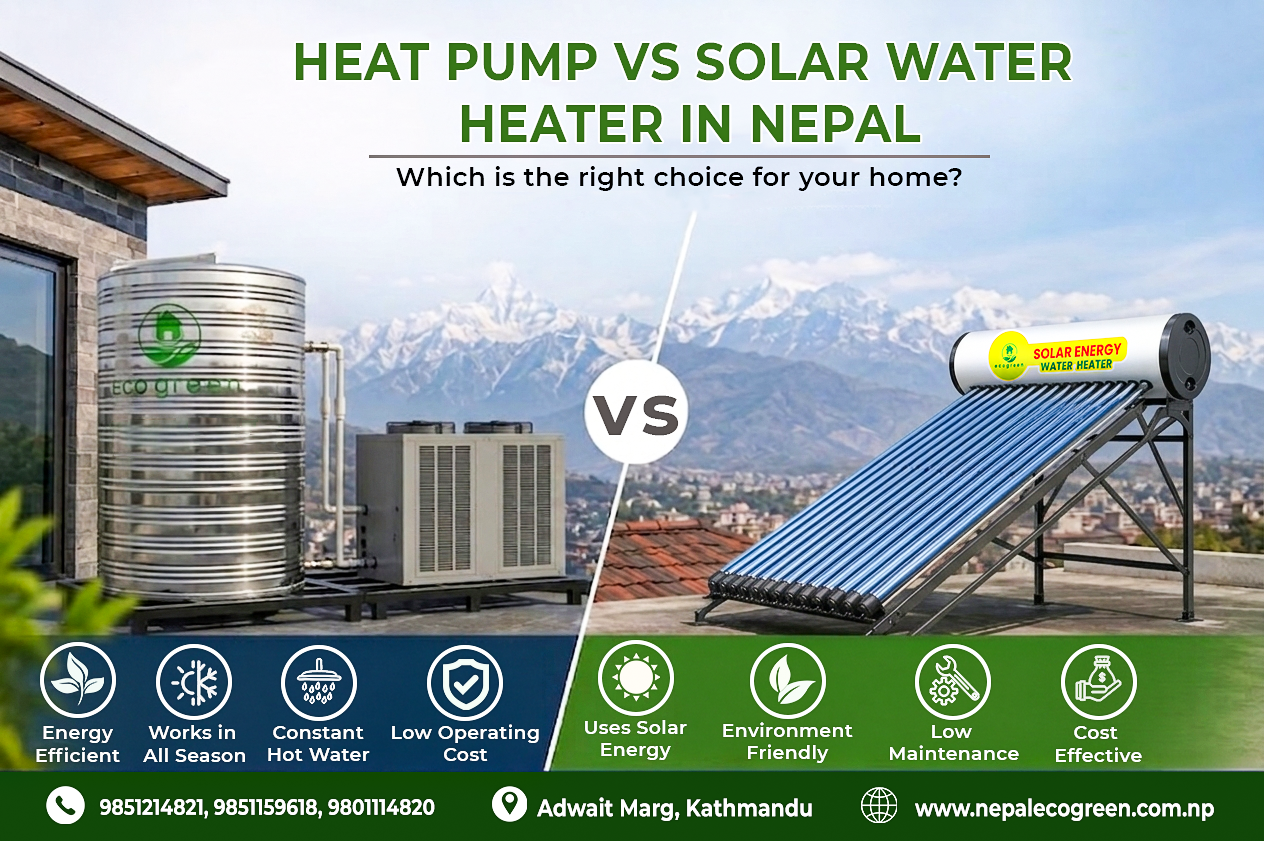
What Is a Heat Pump Water Heater and How Does It Work?
A heat pump water heater does not generate heat directly. Instead, it extracts ambient thermal energy from the surrounding air and transfers it into the water tank — similar to how a refrigerator works, but in reverse. For every 1 unit of electricity it consumes, a well-designed heat pump produces 3 to 4 units of heat energy.
This ratio is called the Coefficient of Performance (COP) and is what makes heat pumps so economical. In Nepal’s market, commercial heat pump water heaters from brands like Nepal ecogreen are available in capacities ranging from 200 litres to 3,000 litres and above — covering everything from a single household to a large hotel with 100+ rooms.
Key characteristics of heat pump water heaters in Nepal:
- Operate on electricity but use 65–75% less power than a conventional electric geyser.
- Deliver consistent hot water at 55–60°C regardless of weather, time of day, or season.
- Modular systems can be expanded as a property grows.
- Typical lifespan of 12–15 years with low maintenance requirements.
- Cold-climate (EVI system) variants are available for altitudes above 3,000m — operating reliably down to -10°C.
What Is a Solar Water Heater and How Does It Work?
A solar water heater uses thermal collectors — either flat plate panels or evacuated tube collectors — mounted on a roof to absorb sunlight and transfer its heat to water stored in an insulated tank. It operates on the thermosiphon principle: heated water naturally rises and is replaced by cooler water, creating passive circulation without a pump.
In Nepal, solar water heaters are widely available from brands including Sunrise, CG, Ultrasun, Osmo, Narayani Solar, Everest Solar, and Suryamukhi Solar. Prices range from NPR 18,000 for a basic residential 15-tube unit to NPR 1,62,500 for a large copper-panel commercial system.
Key characteristics of solar water heaters in Nepal:
- Zero operating cost during daylight hours in sunny conditions.
- No electricity dependency during peak solar hours — valuable during power outages.
- Output is weather-dependent: performance drops significantly on cloudy or rainy days.
- Requires backup heating (electric geyser or immersion heater) for monsoon and winter periods.
- Ideal for locations with 5+ hours of direct sunlight per day.
Nepal’s Climate: The Factor That Decides Everything
Understanding Nepal’s climate is essential before comparing these two technologies. Nepal has four distinct seasons, and each affects hot water system performance differently.
Pre-monsoon and Post-monsoon (March–May, October–November)
These months represent Nepal’s peak tourism seasons and also its best solar conditions. Sunshine is abundant, skies are clear, and solar water heaters perform at or near rated capacity. Both technologies work well during these periods.
Monsoon Season (June–September)
This is the critical challenge period for solar water heaters in Nepal. Four consecutive months of heavy overcast, rain, and cloud cover reduce solar thermal collector output to just 20–40% of rated capacity. For a hotel relying primarily on solar during this period, the gap is filled by emergency immersion heaters or backup geysers — often running continuously, which eliminates the cost savings entirely.
Heat pumps are completely unaffected by monsoon cloud cover. They extract ambient heat from the air regardless of whether the sun is shining. This is the single most important technical difference for Nepal’s hotel and resort operators.
Winter (December–February)
Temperatures in Nepal’s hills and mountains can drop significantly during winter. Standard heat pumps operate efficiently down to about 5°C; below this threshold, performance declines. Cold-climate EVI heat pump units function reliably down to -10°C and are available in Nepal’s market for high-altitude properties. Solar performance improves during clear winter days but remains vulnerable to frost, frozen pipes, and tank damage at high elevations.
Solar Water Heater Nepal Monsoon Performance: The Real Numbers
The monsoon issue deserves its own dedicated section because it is the most misunderstood factor in Nepal’s water heating decision.
During Nepal’s monsoon season, the average daily solar irradiation in Kathmandu Valley drops from a peak of 5.5–6.5 kWh/m² per day (in March–April) to roughly 2.5–3.5 kWh/m² per day. For the hill districts of Pokhara, Nagarkot, and Ghandruk, cloudy conditions are even more persistent. The practical effect on a solar water heater is stark:
| Season | Solar Output | Heat Pump Output | Backup Heating Needed? |
|---|---|---|---|
| Oct–Nov (Peak season) | 85–100% capacity | 100% capacity | No |
| March–April (Spring) | 90–100% capacity | 100% capacity | Rarely |
| Jun–Sep (Monsoon) | 20–40% capacity | 100% capacity | Yes — always |
| Dec–Feb (Winter, hills) | 40–70% capacity | 85–100% capacity | Occasionally |
For hotels running on solar alone during the monsoon, a morning rush serving 50 rooms at 6–9 AM becomes an operational crisis. The backup system runs for hours, consuming electricity at the same rate as a traditional geyser — and the monthly bills reflect that.
This is why professional energy consultants in Nepal consistently recommend heat pumps as the primary system for any hotel or resort that cannot afford hot water failure during monsoon months.
Best Water Heater for Hotels in Nepal: A Clear Decision Framework
For Nepal’s hospitality industry, choosing the best water heater is not simply about price per unit — it is about operational reliability, long-term ROI, and the risk of guest experience failure. Here is a clear framework for hotel and resort decision-makers:
Hill and Urban Hotels (Kathmandu, Pokhara, Nagarkot, Chitwan hills)
Recommendation: Heat pump water heater — primary system, no supplementation needed.
- Monsoon reliability is non-negotiable for hotel operations. Heat pumps deliver.
- Payback period: 2–4 years from energy savings versus electric geysers.
- For a 50-room property spending NPR 1,20,000/month on geysers, a heat pump reduces this to NPR 30,000–45,000/month.
- Over 7 years, cumulative savings versus geysers exceed NPR 50–60 lakh — several times the installation cost.
Terai Lowland Resorts (Chitwan, Bardia, Lumbini, Koshi Tappu)
Recommendation: Solar water heater (primary) + electric backup for monsoon.
- Terai receives substantially more sunshine and has a less severe monsoon than hill districts.
- Boutique-style wildlife resorts with 20–40 rooms benefit from solar’s eco-brand narrative.
- Payback: 2–4 years with properly sized backup system.
- Backup heating must be designed in from the start — not added as an afterthought.
Mountain and High-Altitude Lodges (above 2,500m)
Recommendation: Hybrid solar + cold-climate heat pump.
- Standard heat pumps underperform below 5°C. Cold-climate EVI units are required — available in Nepal market.
- Solar collectors at altitude benefit from intense UV irradiation during clear seasons.
- A hybrid approach combines both advantages while covering the gaps of each technology.
- Capital cost is higher, but the combined system provides year-round reliability at altitude.
The Hybrid Strategy: Solar + Heat Pump for Premium Properties
A growing number of Nepal’s forward-thinking hotels and resort developers deploy hybrid systems — solar thermal collectors as the primary heat source, with a heat pump unit as backup and top-up. This approach delivers the best of both technologies:
- Solar handles approximately 60–70% of annual heating load during favourable months, dramatically reducing heat pump runtime and electricity consumption.
- During monsoon and overcast periods, the heat pump carries the full load without any guest-facing disruption.
- The combined system has higher upfront capital cost but delivers the best long-term economics.
- Particularly valuable for properties pursuing LEED certification, Green Globe accreditation, or Nepal Tourism Board sustainable tourism recognition.
- The hybrid system creates a powerful marketing narrative — genuine green credentials backed by zero operational compromise.
For a 40–60-room resort with the capital to invest, a hybrid solar-plus-heat-pump system is the gold standard: economically optimal, environmentally compelling, and operationally bulletproof.
Frequently Asked Questions About ecogreen Heat Pumps in Nepal
Final Verdict: Heat Pump vs Solar Water Heater in Nepal
The heat pump vs solar water heater debate in Nepal ultimately comes down to three factors: your property’s location, its operational model, and your tolerance for hot water risk.
| Property Type | Recommended System | Why |
|---|---|---|
| Hill/urban hotel (any size) | Heat pump | Monsoon reliability, lower running cost |
| Terai wildlife resort (20–40 rooms) | Solar + backup | Strong sunshine, eco-brand value |
| Premium resort (40+ rooms) | Solar + heat pump hybrid | Best economics + green credentials |
| High-altitude lodge (3,000m+) | Cold-climate heat pump | Frost risk eliminates standard solar |
| Urban household, Kathmandu | Heat pump or solar | Both viable; solar cheaper upfront |
| Rural home, good sunshine | Solar water heater | Low cost, adequate performance |
Hotels and resorts that make this decision thoughtfully — treating it as the long-term infrastructure investment it is rather than a one-time capex to minimize — will carry a structural operating cost advantage over their competitors for the next decade and beyond.
If you are still unsure which system is right for your specific property, request a site assessment from a certified heat pump or solar installer in Nepal. Nepal ecogreen offer consultation services and can provide property-specific ROI projections before you commit to a purchase.
Why Choose Nepal ecogreen’s Heat Pump?
When it comes to installing a heat pump water heater in Nepal, the supplier and after-sales support matter just as much as the unit itself—and this is where Nepal ecogreen stands apart. With over 900+ successful installations across Nepal and Bhutan, we are the most experienced commercial heat pump provider in the country.
Our client list includes prestigious names like KGH Group, Hotel Barahi, and Taleju Boutique Hotel. These properties frequently return for repeat orders, which is the clearest signal of our commitment to quality.
We don’t simply sell and walk away. Our team is involved at the plumbing design stage to maximize efficiency and remains available for consultation throughout the system’s life. Choose a partner that has already saved over 200 MW hours of electricity for businesses across Nepal.
No obligation. No pressure. Just data.
“Our initiatives are designed to support the sustainable energy goals set by the Alternative Energy Promotion Centre (AEPC) of Nepal.”
Ready to Make the Switch?
Get Expert Advice on the Right Heat Pump for Your Home or Hotel
Talk to our team about sizing, installation, pricing, and savings estimates tailored to your specific property and location in Nepal.
 Contact Us Today